
Chronic spine pain rarely appears all at once. It builds gradually, limiting how you work, sleep, move and show up for family and daily responsibilities.
Many people reach a point where basic treatments no longer help, but major surgery feels like too large a step. That in-between space can feel frustrating and uncertain. Modern spine care now offers more options than simply waiting for pain to worsen or committing to an invasive operation.
With targeted evaluation and newer treatment approaches, patients can take a more active role in decisions about their spinal health. Those living with pain can now pursue neck and spine treatment that fits their condition, goals and daily life.
Interventional spine treatment focuses on treating spine-related pain at its source using targeted, image-guided procedures rather than open surgery. These treatments support spine pain management with conservative care, such as medication and physical therapy. If symptoms persist, minimally invasive spine surgery is considered as a last resort.
Physicians use fluoroscopy or other imaging to precisely place needles, probes or implants at the pain-generating site, limiting disruption to surrounding tissue.
Techniques may include:
Interventional procedures offer a precise and effective approach to spine care that limits tissue disruption while directly addressing the anatomical source of pain. This care model differs from open surgery by emphasizing targeted treatment, shorter recovery timelines and continuation of daily activities within a structured spine pain management plan.
Patients often choose interventional spine treatment for the following reasons:
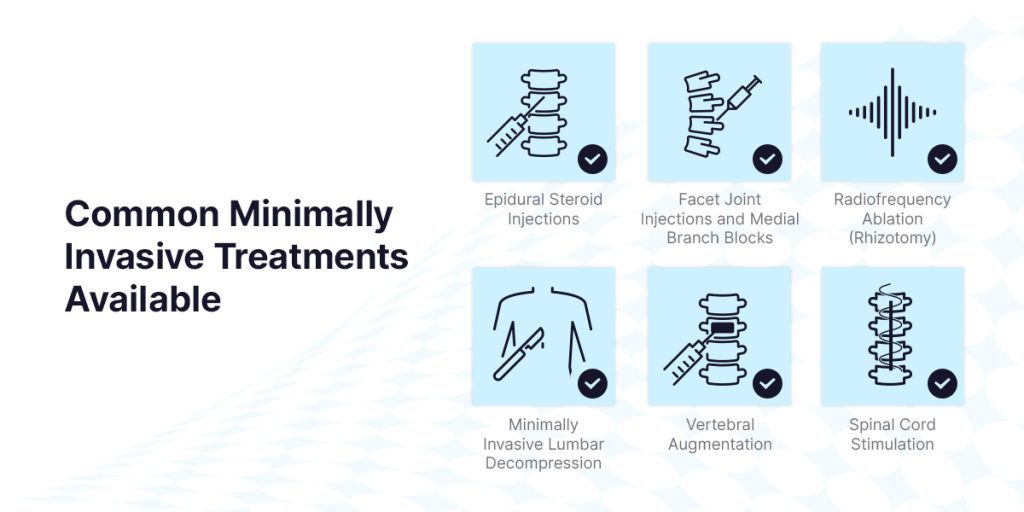
Interventional procedures address specific pain generators within the spine without surgery. This category of care forms part of interventional spine treatment and offers options when medication and physical therapy no longer provide adequate relief.
Each technique targets a defined anatomical structure linked to the symptoms. Providers select the treatment based on their diagnostic findings and the patient’s functional goals.
Epidural injections place corticosteroid medication into the epidural space surrounding irritated spinal nerves. This approach reduces inflammation that contributes to neuropathic pain in the neck or lower back. Back pain specialists often recommend these injections for pinched nerves in the lumbar or cervical spine.
An epidural steroid injection may help:
Medial branch blocks and facet joint injections target pain in the small stabilizing joints of the spine. Providers inject local anesthetic and anti-inflammatory medication into or near the joints to confirm diagnosis and relieve symptoms.
These procedures address axial — non-radiating — neck or back pain rather than nerve compression. Results often guide decisions about longer-lasting treatment.
For patients and doctors, facet joint injections or medial branch blocks can help to:
Radiofrequency ablation uses controlled energy to interrupt pain signals carried by targeted sensory nerves. Physicians place specialized needles near medial branch nerves using imaging guidance.
This technique can treat chronic facet-related pain without affecting the surrounding tissue. Many patients experience relief that lasts for months or even longer.
Undergoing this procedure supports:
Minimally invasive lumbar decompression relieves pain and functional problems caused by nerve compression from spinal stenosis. Surgeons remove small amounts of thickened ligament or bone through very small incisions. This approach limits soft tissue damage compared to traditional open decompression.
This procedure has benefits such as:
Vertebral augmentation stabilizes painful compression fractures within weakened vertebrae. The provider injects bone cement into the affected vertebral body to reduce movement and restore strength. Many patients report rapid pain relief and improved mobility. Techniques for vertebral augmentation include kyphoplasty and vertebroplasty.
This treatment supports:
Spinal cord stimulation modulates pain signals before they reach the brain. Physicians implant thin leads near the spinal cord and connect them to a small pulse generator. Electrical stimulation alters pain perception rather than eliminating sensation, leading to sustained improvements in chronic back pain relief and daily function.
This procedure offers:
These procedures often suit patients whose spine pain matches a confirmed structural diagnosis and hasn’t improved with conservative care. Physical examination and imaging often show nerve compression, joint degeneration or vertebral pathology that explains how symptoms change with posture or movement.
That alignment between anatomy and symptoms allows spine pain management to focus on a defined source rather than generalized discomfort. Eligibility and selection of treatment type depend on the clarity of the diagnosis, symptom behavior and functional impact.
Patients often considered for these procedures include those with:
Many patients notice temporary soreness, stiffness or mild bruising near injection or incision sites. These effects are expected and usually improve within a few days. Pain relief often develops gradually, over days or weeks, rather than immediately. The timeline varies based on the procedure performed and the underlying spinal condition.
Post-procedure care often includes:
Minimally invasive, image-guided care can reduce pain, improve function and help many patients avoid or delay open surgery when conservative treatment is no longer enough. This approach focuses on treating the specific source of the spinal pain. Targeted procedures replace broad symptom management.
At Premier Health Group, interventional spine care is built around accurate diagnosis and procedural precision. Neck and spine treatment is tailored to each patient’s condition, goals and response to treatment, supporting safer outcomes and faster return to daily activity.
Contact us today to schedule a consultation and take your first step toward a life without spinal pain and immobility.